




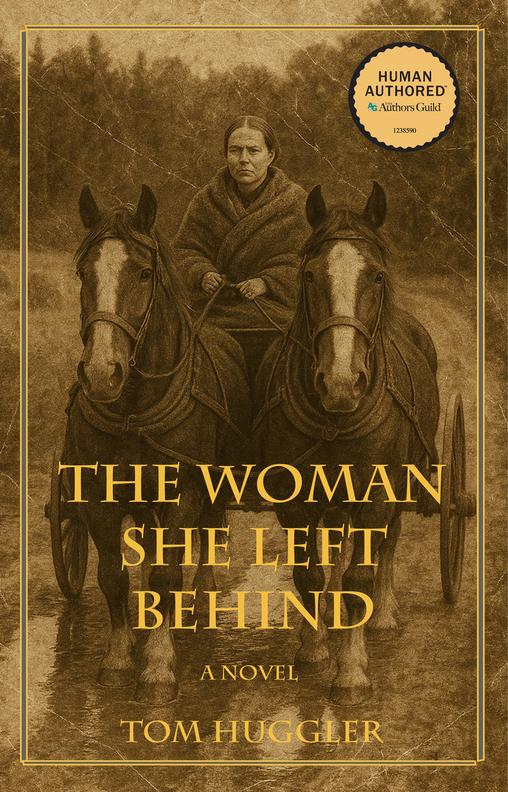
The Grand Rapids Civil War Round Table welcomes a new presenter, Tom Huggler, an Ionia County novelist, with a presentation on his book, "The Woman She Left Behind". The work of historical fiction is based on a real-life mid-Michigan widow who left three children with her farm’s hired man in the spring of 1862 to search for her soldier son dying in New Madrid, Missouri.
The April 8 surrender of several thousand Rebels that held Island No. 10, 60 miles downriver on the Mississippi from Cairo, Illinois, is a historical footnote to the horrendous casualties suffered by both sides at Shiloh immediately preceding the surrender. Huggler will explain the events that precipitated this often-ignored conflict and how it played into his protagonist’s journey, who took her incredible story to the grave.
Signed copies of his award-winning novel will be available after the talk for $20 each.
Tom Huggler (https://www.TomHuggler.com) has been a fulltime freelance writer for more than 40 years and is the author of 20 nonfiction books and two novels, including his latest work, a historical fiction called The Woman She Left Behind. The former high school English teacher has harbored a lifelong interest in the American Civil War. An obscure reference in a family journey propelled Huggler to research how in the spring of 1862 a 40-year-old widowed mother from Sunfield Michigan in Eaton County traveled alone for 600 miles into a war zone to search for her dying son. Huggler’s novel is her untold story.
Membership fees for the 2026-2027 season are $30.00.
Checks can be made out to GRCWRT.
Get your membership/renewal form on our website
membership page or at one of our meetings.
Dues are based on the meeting year, September - June.
We are always looking for new speakers. If you would like to give a presentation to the GRCWRT, or can recommend someone, please contact our program director.
Civil War Notes
Our Next Meeting
Special Announcements:
"The Woman She Left Behind", Book Cover
&
Tom Huggler, The Author
Wednesday
October 21, 2026
Tom Huggler
The Woman
She Left Behind
We Meet At:
Orchard View Church of God
2777 Leffingwell Avenue NE
Grand Rapids, Michigan 49525
Located at the southwest corner of
3 Mile Road NE and Leffingwell Avenue NE
Doors open at 6:30 p.m.
Program begins at 7:00 pm

"Remember that beans, badly boiled, kill more than bullets; and fat is more fatal than powder. In cooking, more than anything else in this world, always make haste slowly. One hour too much is vastly better than five minutes too little, with rare exceptions. A big fire scorches our soup, burns your face, and crisps your temper. Skim, simmer, and scour, are the true secrets of cooking."
~ Union Captain James J. Sanderson
Camp Fires and Camp Cooking, or Culinary Hints for the Solder, 1862
A "Vidette" was the designation of a mounted sentinel on guard duty in advance of an output.
Some Civil War officers were given nicknames based on injuries they sustained in previous wars. The Mexican-American War left Roger W. Hanson with a limp and the name "Benchleg," and James J. Martin without one appendage and the moniker "Old One Wing."
"I feel like anything rather than rejoicing at the downfall of a foe who had fought so long and valiantly, and had suffered so much for a cause though that cause was, I believe, one of the worst for which a people ever fought, and one for which there was the least excuse."
~ Union General Ulysses S. Grant
On the surrender of Confederate General Robert E. Lee
"Our Presidents, Governors, Generals and Secretaries are calling, with almost frantic vehemence, for men. --- "Men! Men! Send us men!" they scream, or the cause of the Union is gone; and yet these very officers, representing the people and Government, steadily and persistently refuse the very class of men which have a deeper interest in the defeat and humiliation of the rebels, than all others.... What a spectacle of blind, unreasoning prejudice and pusillanimity is this! The national edifice is on fire. Every man who can carry a bucket of water, or remove a brick, is wanted; but those who have the care of the building, having a profound respect for the feeling of the national burglars who set the building on fire, are determined that the flames shall only be extinguished by Indo-Caucasian hands."
~ Frederick Douglas
Making the case for African American enlistment in the Union Army
August 1861
